Bridgeport#
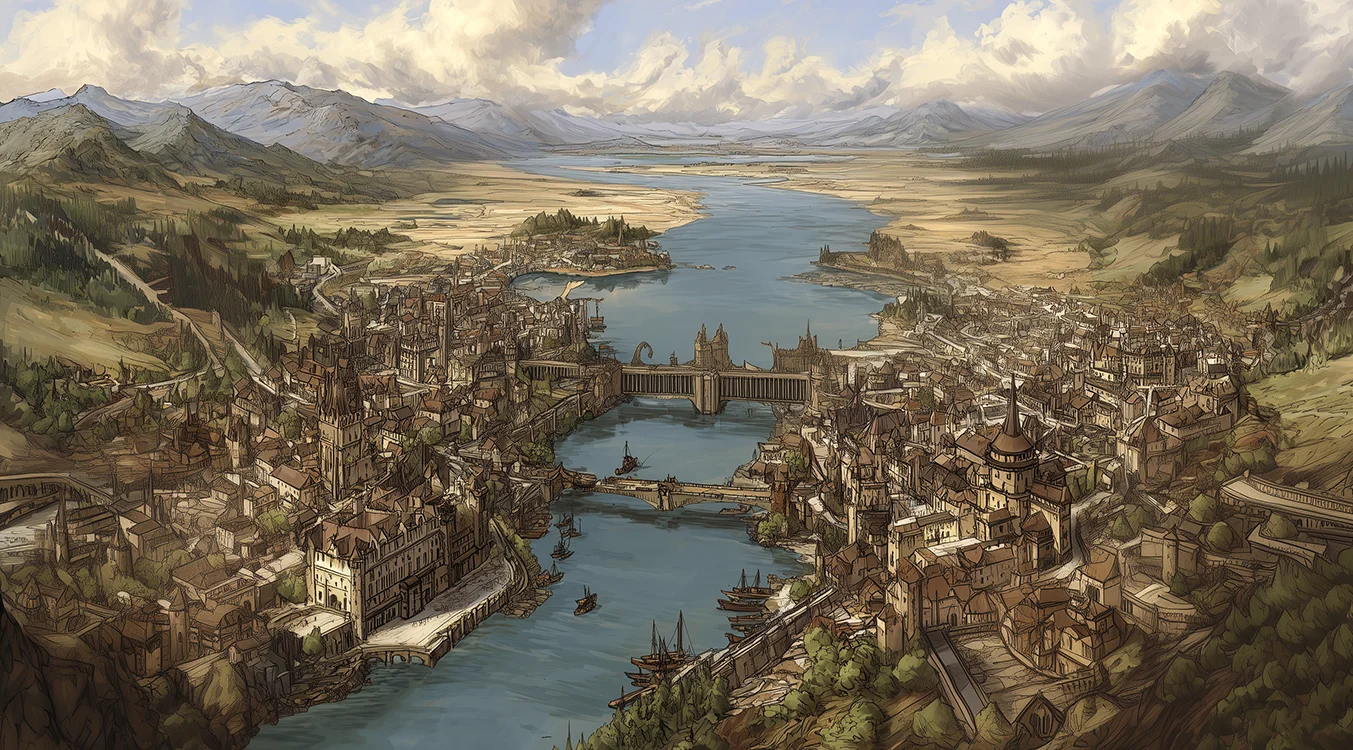
Bridgeport is a freehold city of approximately 8,000 souls situated at the mouth of the Godsfall River where it empties into the Zephyrys Sea at Pell’s Harbor, on the western coast of Algar. It is the realm’s second-largest seaport and a critical hub between the northern heartlands and the wider world. Merchant cogs, river barges, and distant ocean vessels crowd its piers year-round.
It is a city of commerce, ambition, and barely contained chaos — a place where fortunes are made and lost, where every faction has a foothold, and where the streets themselves seem to have opinions.
Governance#
Bridgeport is governed by the Council of Trades, a civic assembly of ten guildmasters whose authority derives from commerce rather than birthright. The current High Convenor is Seraphina Velcross. The Freehold enjoys parliamentary standing equal to a Duchy, giving Bridgeport unusual influence for its size.
The Crown maintains a garrison at Fort Royal, commanded by Colonel Alastair Thorneveil. The garrison answers directly to the royal command in Knightsbridge — not to the Council. The relationship between the two is professionally cordial and privately complicated.
The River and the Bridges#
Two great bridges span the Godsfall River, connecting the southern civic and trade quarter to the mixed residential districts of the north shore.
The Seaward Span is the western crossing — broad, gracefully arched, and built high enough to allow riverboats and barge traffic to pass beneath. Watchposts at either end monitor large carts and unusual cargo. On clear mornings the view from the span is one of the finest in the city, with Pell’s Harbor stretching westward in a sweep of ships, masts, and shimmering water.
Districts & Landmarks#
Saltstone Square#
The beating heart of Bridgeport’s civic life — a busy commercial and social crossroads in the southern district, lined with shops and anchored by an all-faiths shrine. Three prominent public houses face the square: the Strangled Goat Tavern, the Royal Prince Inn, and the Dragonline Lodge. A small militia outpost keeps watch over the area during peak hours.
Guild-certified adventurers tend to gather at the Strangled Goat, where a quasi-official arrangement allows guild and noble missions to be offered inside. It is as good a place as any to find work, hear news, or get into trouble.
Queensway Avenue#
Bridgeport’s principal north-south artery — a wide, well-maintained boulevard lined with guildhalls, merchant houses, and artisan storefronts. Constant traffic flows along its length from the docks to the hills. Lanterns maintained by the Chandlers’ Council keep it bright well into the night, making it one of the safer routes in the city after dark.
Queensway crosses the Seaward Span northward and transitions into the main road toward the Sanctum Hills.
The Racket#
Bridgeport’s most crowded and rough-edged district — a maze of leaning tenements, patched roofs, and hard-packed dirt streets that stand in stark contrast to the cobblestones found elsewhere. Noise, color, and constant motion define the quarter.
At its heart stands the Shrine of the Humble Virtues, a broad temple-like hall dedicated to a triad of Ascendants embodying simple joy, everyday luck, and steadfast hope. The doors are always open. The Racket is poor in coin and notably rich in solidarity — outsiders who mistake its rough appearance for weakness tend to find out otherwise.
Freegate#
The southern edge of old Bridgeport, where a broad stone arch flanked by watchtowers opens toward the farmlands beyond. Road-toll inspectors and agricultural assessors work from the gatehouse. The name endures from the Freehold’s early days, when Bridgeport resisted noble tariffs and insisted this entrance remain open and untaxed. Locals still treat the arch as a symbolic threshold.
Drydock Quay#
A long stretch of the Inner Harbor given over to salvage work and ship repairs. Once a bustling center of construction, it now handles essential maintenance — the rhythmic creak of ropes and clang of tools echoing across the water as crews labor to keep the city’s vessels seaworthy. It carries a faint sense of faded glory, as though the timbers remember a time when entire fleets were launched from these docks.

Seaglass Tower#
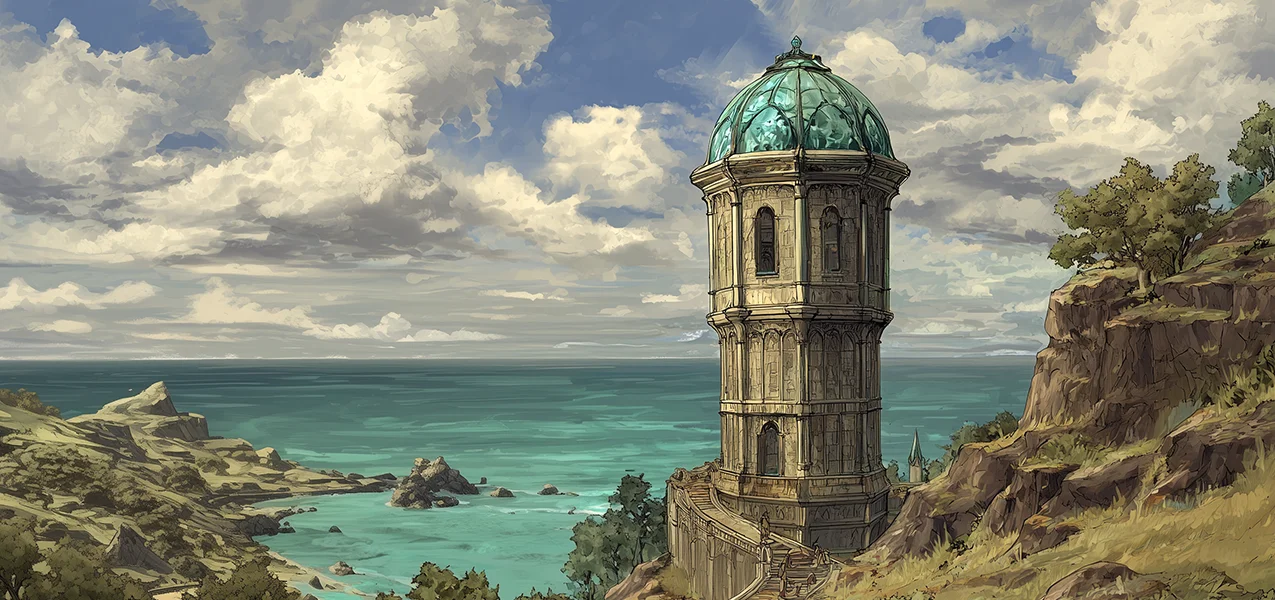
A compact stone fort crowned by a distinctive green-blue glass lantern dome, sitting on a narrow peninsula overlooking Pell’s Harbor. Operated by the city militia, it serves as Bridgeport’s primary watchpoint for approaching vessels. Its lantern guides ships through fog and night. From its battlements, the entire sweep of Pell’s Harbor can be surveyed in a single turn of the head.
Riverbend Mills#
Sits along the banks of Stonewash Creek, a fast cold run of water descending from the Livingstone Mountains before emptying into the Inner Harbor. The complex contains wheelhouses, saw frames, drying racks, and storage sheds. The air is thick with the mixed scents of cut wood and ground grain, and wagons come and go at all hours.
Northwood Stands#
The dense woodland bordering Bridgeport’s northern edge — rich in game, timber, herbs, and hidden trails. A few licensed trappers work its outskirts. Most avoid the deeper groves without experienced guides. Hunters speak of faint blue lights drifting between the trees and of tracks that appear and vanish again.
Roads leave Bridgeport in two directions from here: northwest into the Livingstone Mountains through Hayden Gap, and northeast through rolling highlands toward the Sanctum Hills.
Faith#
Three temples serve Bridgeport’s spiritual life openly:
- Temple of Radiant Light — devoted to Aard, on Queensway Avenue
- Shrine of the Iron Oath — devoted to Kelleth
- Umbral House — devoted to Noctis, on the northern outskirts
Atmosphere#
Bridgeport smells like salt, fish, and ambition. Its streets are loud, its politics are complicated, and its people are pragmatic above all else. It is not a safe city, but it is an interesting one — and for those with the nerve to navigate it, full of opportunity.
Festivals, market days, and riverfront gatherings knit its diverse residents together. Travelers often remark that the city feels both ancient and newly rising — restless with potential, yet firmly rooted in tradition.